When Will It Stop?
By Kimberly Richardson
June 1, 2026
Soft peach clouds drifted across the gray sky as I headed to the dojo early Saturday morning on May 9. Normally, I walk the mile-plus distance to work, breathing in the fresh air, letting it wake my body and help me rough out a plan for class. With Bach’s cello suites and Prince’s Raspberry Beret streaming in my ears, I stretch my torso and swing my arms in wide directions, feeling my way toward a theme for our morning training.
But this day was different. I drove, knowing I needed time to meet with a new student before class, greet visitors, teach my classes, and then jump back in the car to visit friends in West Seattle. As I turned off Lake City Way and followed the side road in search of parking, blue and red flashing lights shattered the morning. Only then did I notice a small group of people, some veiled in orange and brown hijabs, standing on the corner outside the Growler Pub, across the street from Two Cranes. As I looked closer, I saw bowed heads and heard what sounded like howls and wailing. Nothing about the scene made sense to me. When I turned into the public parking lot across the street from the dojo, several policemen waved me on. Then I saw it: at least 12 police cars lined up everywhere. Yellow crime tape stretched across the space.
“Keep moving!” the cop yelled at me, directing traffic away from the scene.
I poked my head out of the car window, explaining that there were 20 children, family members, and instructors in the building across the street, and asking whether they were safe. They assured me they were. I took a deep breath and parked, sensing that something terrible had occurred.
It is in moments like these—when I am left wondering how to face a tragedy—that I have come to trust my aikido practice. I am grateful to have learned to take a conscious breath, keep my cool, and move past that potential ‘freak out’ moment. I entered the dojo, bowed into the space, removed my shoes, and smiled at the parents sitting on the bench watching their children. Then one of my less tactful students called out, “There was a murder last night across the street!”
It flashed on me that I have taught in challenging times before, and I found myself wondering: How do we stare into the unknown? For all I didn’t know about what had transpired the night before, I knew to assess the energy in the room, change my clothes, and bow into class. Halfway through the hour, a stocky policeman stepped through the door and began to scan the room.
“How can I help you?” I asked, stepping off the mat to greet him. He wanted to know what I might have seen or heard the night before and whether our security cameras might offer anything useful. Sadly, they are not aimed in the direction that could help in the search for the assailant. After taking my contact information, he left. I clapped my hands to signal the end of the training segment. When everyone had lined up, I said:
“How fortunate we are to practice together today. There are many reasons to train. Some of us come for exercise—to work up a good sweat—and to build strength, and that’s great. But there’s more at stake. Morihei Ueshiba spoke of Aikido as ‘medicine for a sick world.’ Here today, we have an opportunity to study the reality of life and death, and that truth feels immediate when we face a sword strike aimed at our heads. Yet there is a deeper layer still. We cannot ignore what happened next door just hours ago. It is hard to fathom that people can shoot one another in cold blood, yet it happens every day. In the face of that, we can deepen our practice.”
At that moment, my mind filled with a kaleidoscope of images, and Terry Dobson came vividly before me. Years earlier, on a park bench in Eugene, Oregon, he told me about sitting at O Sensei’s deathbed and hearing him say, “Onegaishimasu (please).”
“That rattled my soul,” he said, laughing softly and nearly crying. Even though Terry did not know what to do with the request, he returned to the States and spent the rest of his life teaching non-violence.
“How do we practice non-violence? How do we become upright, courageous people who can face brutality with conviction? We can support one another in imagining a world where equanimity and kindness are recognized as true forms of leadership.” We can remember that we are part of a vast global family, joined by something deeper than all that has divided us since the beginning of time—the great ocean to which we all belong. I find myself returning to the ancient Buddhist practice of Tonglen: breathing in the suffering of others and breathing out peace and compassion.
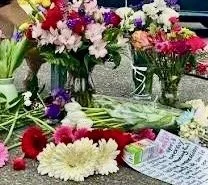
The 26-year-old victim was a vibrant young man who went to school with the owner’s son. When I returned to the dojo later that afternoon, the police were still on site. I learned that the coroner had just arrived. More than 100 people were gathered in the street, many moving up and down in prostrations and sounding calls back and forth that hung despairingly in the air. As I moved through the crowd, bowing my head in respect and silently repeating I am so sorry for your loss, I placed my hand over my heart.
When will this ever stop?